

Short-term bullish, long-term bearish Hyperliquid:
The bull argument:
- regulation = awareness
- regulation =/ permissionless trading (regarb, the real moat, is still in effect)
- most traders have no idea that perpetual futures even exist. this will undoubtedly introduce Hyperliquid to more users
- regulation is really just a dial that drives roadmap, but Hyperliquid needs to drive the dial, not Robinhood/CME. them investing in the Hyperliquid Policy center (run by ex-Variant CLO @jchervinsky, very bullish on this initative)
- Jeff and co. are still the preeminent system architects of good perps infrastructure, which is valuable even if existing products become commoditized
The bear argument:
- perp legalization without stablecoin clarity means the margin/collateral layer is still murky for compliant institutions
- Hyperliquid's core user (onchain degen) is a small TAM, and the users that legislation unlocks (e.g., options + future traders, institutions) will likely route through regulated wrappers before it reaches HL
- Robinhood + CME can build a comprable retail trading product to Hyperliquid. they could easily have similar/greater depth of liquidity if Citadel were involved. this will likely force Hyperliquid fees to compress
- traders + investors still don't care about custody and censorship. maybe eventually, but not today
If I had to guess how this plays out on a 5 year time horizon, I'd say the pie for perps grows, Hyperliquid overall OI and volume increases but as a % of total perps volume shrinks signficantly, and margins compress due to offchain competition.

明显感觉 @okx 在拥抱Agentic Economy的脚步快起来了。
这次新推出的OKX OnchainOS要主打全面Agent兼容,换句话说,以前OKX wallet要给“人”打造最好用的数字钱包,现在的OnchainOS目标是给未来的“AI Agent”打造一套数字操作系统。
为什么这么做,就像 @zakk_okx 老板所说,OnchainOS不单纯是一个新产品,而是一个面向开发者集团战略升级的标志。
我再补充谈两点看法:
1)OKX Wallet、OKX DEX之前是在多链适配和流动性聚合上“卷出来”的硬实力。但说实话,在增量不足的当下,单纯服务“人”很吃亏,毕竟用户池就那么大,还缺乏忠诚度。只靠上新币、领空投、新链支持等碎片化热点里反复横跳很难体现出优势。
而服务Agents就不一样了,这会是全新比拼infra迭代速度的新赛道,目前竞品极少,抢先布局必然能再次获得先发优势;
2)之前OKX Wallet压倒MetaMask等钱包靠的是精美的钱包UI界面和丝滑的用户体验,但Agent不需要这些。它需要的是标准化的API调用、极低的响应延迟和自动化的执行环境。这是一套全新的课题,对团队的技术底蕴提出了更高要求。
这恰好符合OKX一向主打技术Infra导向的底色,能否抓住这次Agent给Crypto提出的全新infra迭代逻辑,能不能在这场抢夺AI Agent新流量入口的战争中获得胜利,对OKX和 @XLayerOfficial 这条新链而言都太关键了,赢了就不仅仅是某个“产品”的成功了,而是一次“全生态”洗牌的机会;

I love this post. Ethereum is the World Computer. Free finance is one important use of the World Computer, if we can police our own to actually keep the finance free. However, you can do so many more things with a computer, so we must never stop dreaming big. In a world gone mad, the Infinite Garden is a sanctuary.
Picture Ethereum's role as the unstoppable coordination layer of all liberatory technology in a movement of broader d/acc. The leviathan we defend against is very powerful. In the mundane case, state capacity for oppression might trend towards infinity. In the extreme case, our civilization might actually birth a self-assembling exocapital computer eschaton.
We might need to survive in the Miyazaki patchwork future, where we can yet live in self-sovereign off-grid Fortress New Hampshire network states despite an all-powerful malevolent adversary. Our hardware and software can be formally verified to be mathematically airtight. Our air, water, and food can be locally-generated and protected from supply-chain attack. Our printers will produce the plows, swords, ghost guns, and any other tools of production or defense. Our locally-operated computer katechons can save us from a perpetual onslaught of drones, cyberattacks, and bioweapons.
In such a most-adversarial world, Ethereum is the layer which allows for safe communication and trade between sanctuary islands. It is the layer which helps those create new sanctuary islands. The unstoppable forever network will see the preservation of human agency into the stars and beyond.

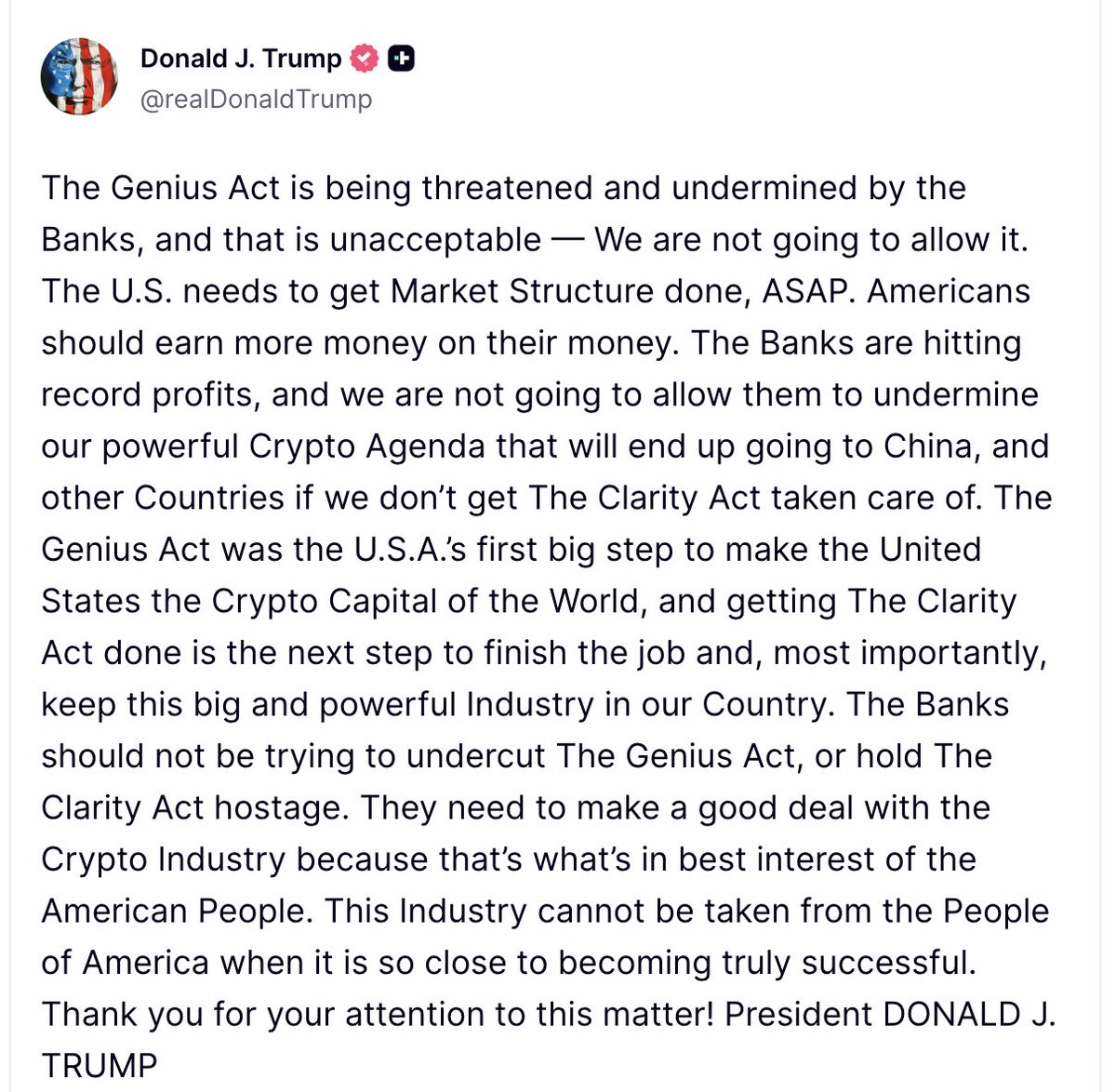
Glad to see that the President lands on the side of logic and sanity on the stablecoin yield issue. Banks make plenty of money. American savers deserve options. Competition is good. If selfish anti-American Wall Street lobbying kills crypto progress then foreign jurisdictions prevail.

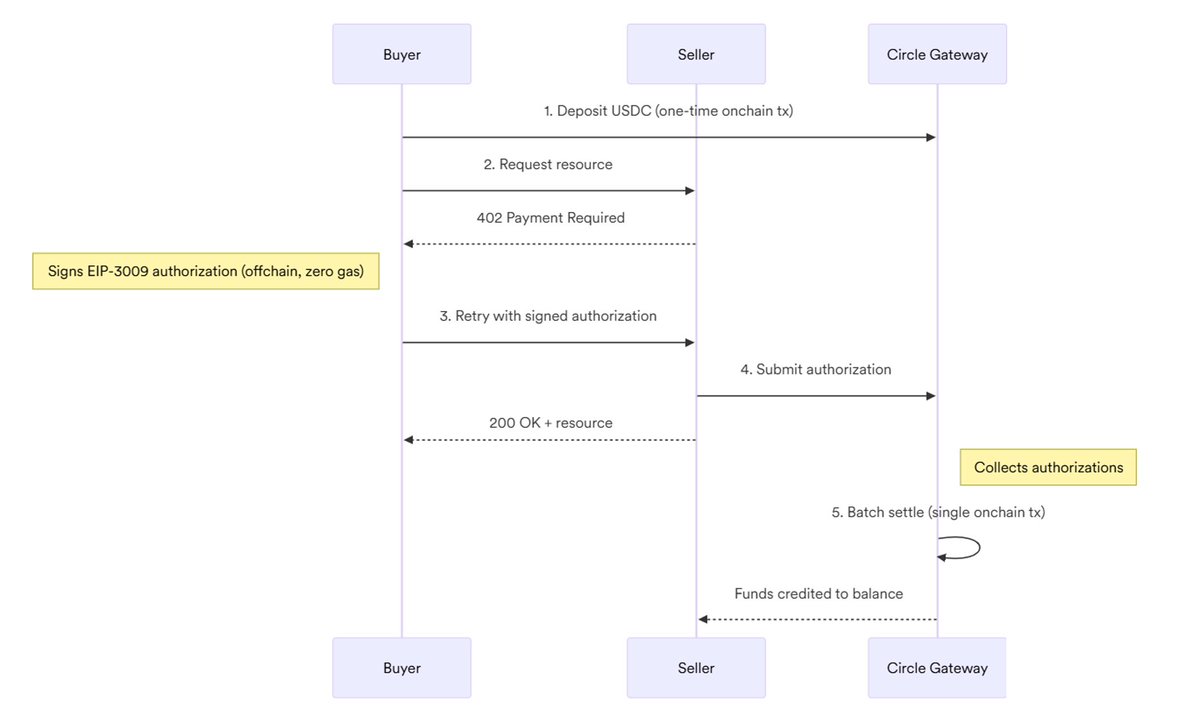
How do Circle’s Nanopayments work?
@circle has unveiled a new feature called Nanopayments.
It allows transfers as small as $0.000001 while claiming zero gas fees. How is that possible?
The secret lies in batched settlement.
If every payment created its own onchain transaction, gas costs would quickly add up.
Instead, Nanopayments collects users’ offchain payment signatures through the Circle Gateway. The system calculates net balances and periodically settles accumulated payments in a single batch.
How Nanopayments Work
Here is a simplified look at the process:
1. Deposit: The buyer sends USDC from their wallet to the Circle Gateway Wallet. This is an onchain transaction and gas is paid only once at the initial deposit.
2. Request and negotiate: The buyer requests a paid resource from the seller. The seller can respond through the x402 protocol.
3. Sign authorization: The buyer signs an EIP-3009 message. This is an offchain signature that authorizes payment to the seller and requires no gas.
4. Settle and serve: Circle Gateway verifies the signature and checks the buyer’s balance. The corresponding amount is locked. The seller immediately delivers the paid resource to the buyer.
5. Batch settlement: The Gateway periodically aggregates pending offchain signatures, calculates net balances, and settles them onchain in a single transaction.
In other words, thousands of offchain payment transactions are consolidated into one onchain transaction. That is why the effective gas cost approaches zero.
Security Model
One point worth highlighting is that the offchain payment authorization process might appear custodial at first glance. However, Circle Gateway is designed to be non custodial.
Circle Gateway runs inside an AWS Nitro Enclave TEE. Within this environment, the system verifies EIP-3009 signatures, computes batch settlement results, and signs the final batch transactions. The TEE signing keys are securely protected using AWS KMS. Even Circle employees cannot access the enclave or the keys.
Thoughts
There have been many attempts to implement micropayments. Most approaches simply relied on sending transactions on networks with extremely low gas fees.
Nanopayments takes a different path. By aggregating offchain transactions and processing them in batches, it dramatically reduces gas costs. (For reference, the USDT chain @Stable has implemented a similar concept at the network level called the USDT Transfer Aggregator.)
This approach could become especially meaningful in the future. As the agentic economy evolves, AI agents may increasingly stream payments in real time. Nanopayments creates the infrastructure that makes that model viable.

Over the past year, many people I talk to have expressed worry about two topics:
* Various aspects of the way the world is going: government control and surveillance, wars, corporate power and surveillance, tech enshittification / corposlop, social media becoming a memetic warzone, AI and how it interplays with all of the above...
* The brute reality that Ethereum seems to be absent from meaningfully improving the lives of people subject to these things, even on the dimensions we deeply care about (eg. freedom, privacy, security of digital life, community self-organization)
It is easy to bond over the first, to commiserate over the fact that beauty and good in the world seems to be receding and darkness advancing, and uncaring powerful people in high places are making this happen. But ultimately, it is easy to acknowledge problems, the hard thing is actually shining a light forward, coming up with a concrete plan that makes the situation better.
The second has been weighing heavily on my mind, and on the minds of many of our brightest and most idealistic Ethereans. I personally never felt any upset or fear when political memecoins went on Solana, or various zero-sum gambling applications go on whatever 250 millisecond block chain strikes their fancy. But it *does* weigh on me that, through all of the various low-grade online memetic wars, international overreaches of corporate and government power, and other issues of the last few years, Ethereum has been playing a very limited role in making people's lives better. What *are* the liberating technologies? Starlink is the most obvious one. Locally-running open-weights LLMs are another. Signal is a third. Community Notes is a fourth, tackling the problem from a different angle.
One response is to say "stop dreaming big, we need to hunker down and accept that finance is our lane and laser-focus on that". But this is ultimately hollow. Financial freedom and security is critical. But it seems obvious that, while adding a perfectly free and open and sovereign and debasement-proof financial system would fix some things, but it would leave the bulk of our deep worries about the world unaddressed. It's okay for individuals to laser-focus on finance, but we need to be part of some greater whole that has things to say about the other problems too.
At the same time, Ethereum cannot fix the world. Ethereum is the "wrong-shaped tool" for that: beyond a certain point, "fixing the world" implies a form of power projection that is more like a centralized political entity than like a decentralized technology community.
So what can we do? I think that we in Ethereum should conceptualize ourselves as being part of an ecosystem building "sanctuary technologies": free open-source technologies that let people live, work, talk to each other, manage risk and build wealth, and collaborate on shared goals, in a way that optimizes for robustness to outside pressures.
The goal is not to remake the world in Ethereum's image, where all finance is disintermediated, all governance happens through DAOs, and everyone gets a blockchain-based UBI delivered straight to their social-recovery wallet. The goal is the opposite: it's de-totalization. It's to reduce the stakes of the war in heaven by preventing the winner from having total victory (ie. total control over other human beings), and preventing the loser from suffering total defeat. To create digital islands of stability in a chaotic era. To enable interdependence that cannot be weaponized.
Ethereum's role is to create "digital space" where different entities can cooperate and interact. Communications channels enable interaction, but communication channels are not "space": they do not let you create single unique objects that canonically represent some social arrangement that changes over time. Money is one important example. Multisigs that can change their members, showing persistence exceeding that of any one person or one public key, are another. Various market and governance structures are a third. There are more.
I think now is the time to double down, with greater clarity. Do not try to be Apple or Google, seeing crypto as a tech sector that enables efficiency or shininess. Instead, build our part of the sanctuary tech ecosystem - the "shared digital space with no owner" that enables both open finance and much more. More actively build toward a full-stack ecosystem: both upward to the wallet and application layer (incl AI as interface) and downward to the OS, hardware, even physical/bio security levels.
Ultimately, tech is worthless without users. But look for users, both individual and institutional, for whom sanctuary tech is exactly the thing they need. Optimize payments, defi, decentralized social, and other applications precisely for those users, and those goals, which centralized tech will not serve. We have many allies, including many outside of "crypto". It's time we work together with an open mind and move forward.

You have zero control over where you're born, yet billions of people in the world are shut out of accessing financial tools because of it.
Finally, this is changing with crypto. Getting access to sound money, loans, stocks, etc from your phone anywhere in the world is foundational to progress.

I used to hate the idea of borrowing against your Bitcoin
But I was presented with new information and completely changed my mind
I used to think that you should just sell Bitcoin to buy the things that you need if you don't have enough income
But now I understand that most people won't care about Bitcoin until it's $1M+
Most of the Bitcoin supply will be bought by institutions until it reaches $1M+
The institutional investors who understand Bitcoin will never sell
For example, Strategy is building products that allow it to essentially print fiat so it can get as much Bitcoin as possible
Why should I sell my Bitcoin to Strategy?
Why should I pay the taxes associated with selling my Bitcoin?
Why should I pay the exchange fees to sell my Bitcoin?
If someone wants to be paid in Bitcoin, I will gladly give it to them over fiat
But if I have to sell my Bitcoin to buy the things that I need, then I would rather just borrow fiat against a very small portion of my stack and pay that loan back with devalued dollars
Of course, there are still risks associated with borrowing against your Bitcoin
It's still a relatively new asset class, so it's very volatile
You could be liquidated and lose your entire stack if you borrow against everything you have
I think it would be smart to limit the percentage that you borrow against
The limit would be up to you
Think about how much Bitcoin's price could fall before you make your decision
Eg. Borrowing against 5% of your stack with a loan-to-value of 50% means you can only get liquidated if Bitcoin's price sees a 96%+ drawdown
Borrowing against 50% of your stack with an LTV of 50% means you would get liquidated with a 67.5% drawdown
This is with a liquidation LTV of 80%
The lower your LTV, the safer your loan
Most people won't understand the significance of Bitcoin until fiat is dead
At that point, they won't be buying it
They will be working for it

在 Uniswap 在诈骗代币集体诉讼案 (Risley v. Uniswap Labs)中的法官 Katherine Polk Failla ,也是负责 SEC 诉 Coinbase 案的法官,在裁决书中有几个关键观点:
- Uniswap 提供的只是基础协议(底层代码)。就像汽车制造商不为酒驾司机负责、软件开发者不为利用该软件进行的诈骗负责一样,Uniswap Labs 不应对第三方发行的垃圾币(Scam Tokens)承担赔偿责任。
- 无法确定被告。诈骗者通常是匿名的。原告因为找不到真正的骗子,转而起诉“有钱且有名”的平台方,法院认为这在法律上是站不住脚的。
- 法律监管的真空。目前的联邦证券法并不能涵盖这些去中心化协议的行为。如果原告觉得不公平,应该去找国会修法,而不是让法官“硬套”现有的证券法。
Uniswap 胜诉的关键在于其核心智能合约是去中心化且不可更改的。
如果协议保留了过大的“管理员权限”(Admin Keys)来控制交易、冻结资产,法官可能会认为这是一个“中心化实体”,从而让你承担监管责任。
也就是 代码越自治,开发者越安全。
而在这之前还有一个诉讼案件受人关注,那就是 Tornado Cash被指控 洗钱、违反制裁规定 (OFAC),最后开发者因“未能阻止非法资金流”面临刑事指控
目前,美国的法律体系对证券法领域的 DeFi 创新相对宽容(倾向于认为代码无罪),但对 “反洗钱/金融制裁” 领域则非常严苛。
Finally, the block building pipeline.
In Glamsterdam, Ethereum is getting ePBS, which lets proposers outsource to a free permissionless market of block builders.
This ensures that block builder centralization does not creep into staking centralization, but it leaves the question: what do we do about block builder centralization? And what are the _other_ problems in the block building pipeline that need to be addressed, and how? This has both in-protocol and extra-protocol components.
## FOCIL
FOCIL is the first step into in-protocol multi-participant block building. FOCIL lets 16 randomly-selected attesters each choose a few transactions, which *must* be included somewhere in the block (the block gets rejected otherwise). This means that even if 100% of block building is taken over by one hostile actor, they cannot prevent transactions from being included, because the FOCILers will push them in.
## "Big FOCIL"
This is more speculative, but has been discussed as a possible next step. The idea is to make the FOCILs bigger, so they can include all of the transactions in the block.
We avoid duplication by having the i'th FOCIL'er by default only include (i) txs whose sender address's first hex char is i, and (ii) txs that were around but not included in the previous slot. So at the cost of one slot delay, only censored txs risk duplication.
Taking this to its logical conclusion, the builder's role could become reduced to ONLY including "MEV-relevant" transactions (eg. DEX arbitrage), and computing the state transition.
## Encrypted mempools
Encrypted mempools are one solution being explored to solve "toxic MEV": attacks such as sandwiching and frontrunning, which are exploitative against users. If a transaction is encrypted until it's included, no one gets the opportunity to "wrap" it in a hostile way.
The technical challenge is: how to guarantee validity in a mempool-friendly and inclusion-friendly way that is efficient, and what technique to use to guarantee that the transaction will actually get decrypted once the block is made (and not before).
## The transaction ingress layer
One thing often ignored in discussions of MEV, privacy, and other issues is the network layer: what happens in between a user sending out a transaction, and that transaction making it into a block? There are many risks if a hostile actor sees a tx "in the clear" inflight:
* If it's a defi trade or otherwise MEV-relevant, they can sandwich it
* In many applications, they can prepend some other action which invalidates it, not stealing money, but "griefing" you, causing you to waste time and gas fees
* If you are sending a sensitive tx through a privacy protocol, even if it's all private onchain, if you send it through an RPC, the RPC can see what you did, if you send it through the public mempool, any analytics agency that runs many nodes will see what you did
There has recently been increasing work on network-layer anonymization for transactions: exploring using Tor for routing transactions, ideas around building a custom ethereum-focused mixnet, non-mixnet designs that are more latency-minimized (but bandwidth-heavier, which is ok for transactions as they are tiny) like Flashnet, etc. This is an open design space, I expect the kohaku initiative @ncsgy will be interested in integrating pluggable support for such protocols, like it is for onchain privacy protocols.
There is also room for doing (benign, pro-user) things to transactions before including them onchain; this is very relevant for defi. Basically, we want ideal order-matching, as a passive feature of the network layer without dependence on servers. Of course enabling good uses of this without enabling sandwiching involves cryptography or other security, some important challenges there.
## Long-term distributed block building
There is a dream, that we can make Ethereum truly like BitTorrent: able to process far more transactions than any single server needs to ever coalesce locally. The challenge with this vision is that Ethereum has (and indeed a core value proposition is) synchronous shared state, so any tx could in principle depend on any other tx. This centralizes block building.
"Big FOCIL" handles this partially, and it could be done extra-protocol too, but you still need one central actor to put everything in order and execute it.
We could come up with designs that address this. One idea is to do the same thing that we want to do for state: acknowledge that >95% of Ethereum's activity doesn't really _need_ full globalness, though the 5% that does is often high-value, and create new categories of txs that are less global, and so friendly to fully distributed building, and make them much cheaper, while leaving the current tx types in place but (relatively) more expensive.
This is also an open and exciting long-term future design space.
https://t.co/CdpE9ugFxE

Bitcoin is a Ponzi.
Cool. Show me the operator.
• Who’s running it?
• Who’s promising 12%?
• Who’s cutting checks from fresh deposits?
Exactly.
Bitcoin is open-source code + math + supply and demand.
No central authority. No emergency money printer.
Every transaction? Public.
Every rule? Known in advance.
A Ponzi hides in the dark.
Bitcoin runs in broad daylight.
Bitcoin is the anti-Ponzi scheme.

由于Aave治理纠纷的问题,最近在考虑是否要换更多 $AAVE 到 $MORPHO, 最后没有动。以下考虑
主要是Morpho目前价值捕获太弱,虽然有Apollo在买,但协议本身的特性决定了大部分利润被Curator赚了。
Aave这边虽然Labs开出5000万分手费,但未来100%协议收入都给DAO,代币价值捕获完整。
我认为重要节点
应该关注Aave V4的上线,如果未来V4很顺利,稳定运行且受到好评,那么前面的事大概率就过去了,就像大家现在也不怎么骂uni了,以前天天fud MakerDAO,现在觉得也是靓仔了。
5000万确实很多,但对比同行Uni、Sky,年支出差不多也是这个水平,只能说Crypto劳动力太贵了。
如果V4的推进出现问题,特别是之前Labs想强推V4同时把V3关掉,我觉得是很傻的,出现这种问题我会卖掉它。
Morpho这边资源确实很好,我持有一些,但比例比较小,背靠Coinbase能输血,Apollo也准备要买代币,实实在在的利好能看得见,短期我不会出售,但也不考虑继续增持了。
最近,都在传 @opinionlabsxyz 即将TGE的消息,其实大家都很清楚,在 @Polymarket 牵引的预测市场主叙事呼啸般形成主升浪之前,一定会存在一场事关预测市场的叙事“暗战”。
关键就在于,在Polymarket通过“政治博弈”把Mindshare拉到极致后,后来者该如何分这杯羹的问题?今天来围绕 Opinion 谈几点我的观察:
1)Opinion已经积累了足够的市场声量,不仅在Pre-A拿到了Hack VC和Jump的2,000万美金,也有了BSC生态系预测市场龙头的预期,且能在公测后短短60天内被刷出超百亿美元的交易量。
这发展的增速,其实是大资金在站队投票,也反应了市场对于其在预测市场抢先登陆的预期;
2)Polymarket的成功背靠着美国总统大选、美联储主席候选人,伊朗战争是否打响等大流量的事件驱动型盘口,Opinion势必得另辟蹊径才行。
它选择了构建一套“预测原语”,重点不在是关乎二元期权是与否的结果,而是预期落地前的整个过程中,对“概率波动”进行实时定价。
比如,Opinion重点发力的Pre-token Generation Events,就在很多项目还是信息黑箱的时候,直接把它转化成了可以博弈的链上资产,即实现了对预期的定价,又构成了对一级市场项目落地前的软着陆。
这种将“虚无的预期”变成“真实的流动性”的能力,就是Opinion想在加密原生玩家眼中卡位的关键,和之前很多项目试图改变Bounding Curve发币形态来定价的导向差不多,但Opinion的方式会更直接;
3)以往开一个预测盘口需要人工审核、手动设置结算条件。Opinion通过 AI预言机实现了“即时开盘”。它的意义在于让资产化预期本身变得足够自动化。
这意味着,它不仅能承载宏观叙事,更能下沉到微观领域。比如一个DeFi协议的TVL波动、一个NFT系列的地板价预期,都能在瞬间变成一个可交易的市场。
这种高频且极低的摩擦成本,让它可以覆盖大量Polymarket顾及不到的、具有24/7波动性的加密原生话题和宏观指标。
4)数据显示,Opinion的平均交易规模高达2,500美元以上,这明显不止是散户在小赌怡情,显然有机构在其利用其高流动性在预测市场进行风险对冲的交易需求。
这其中必然有不少为了刷 $OPN 积分来的刷单水分,但撇开刷单,一个平台若用户画像中机构和套利者能占到较大程度比重,其实是在侧面验证其底层基建的“承载力”。
能让大资金在预测市场里像做衍生品一样进行精密的对冲,而不只是散户层面的“赌博”,这才是未来预测市场2.0要发力的目标。而要做到此,AI预言机的响应速度,流动性深度、结算逻辑等都会成为考验;
以上。
预测市场最终一定会靠Polymarket引爆并引入大量场外增量用户没错,但Opinion思路是定义一种全球概率金融基建的“协议层”逻辑,这样做很Crypto-Native,短期一定会更对加密原生市场友好。但也意味着,其真正的价值和潜力得观察TGE之后的表现,NFA,静观其变。

今儿看了Dune这篇有个点还是很让我惊讶的
“By token, USDC dominated with $8.3T — nearly 5x USDT's $1.7T — despite being 2.7x smaller in supply.”
在转账额上,USDC是USDT的5倍 - 作为一个比USDT规模小2.7倍的稳定币
换句话说,现在USDC 更像“工作中的钱”,偏交易型稳定币;USDT 更像“存在钱包里的钱”,偏储值型稳定币
忽然让我想到费雪公式 MV = PT。即使M更小,只要V足够高,就能支撑更大的交易总量T
Circle最近股价飙涨,感觉除了财报的数据超出预期,这个“夸张”的USDC的转账额/流通速度,可能也是一个市场非常买单的点🤔
This is quite an impressive experiment. Vibe-coding the entire 2030 roadmap within weeks.
Obviously such a thing built in two weeks without even having the EIPs has massive caveats: almost certainly lots of critical bugs, and probably in some cases "stub" versions of a thing where the AI did not even try making the full version. But six months ago, even this was far outside the realm of possibility, and what matters is where the trend is going.
AI is massively accelerating coding (yesterday, I tried agentic-coding an equivalent of my blog software, and finished within an hour, and that was using gpt-oss:20b running on my laptop (!!!!), kimi-2.5 would have probably just one-shotted it).
But probably, the right way to use it, is to take half the gains from AI in speed, and half the gains in security: generate more test-cases, formally verify everything, make more multi-implementations of things.
A collaborator of the @leanethereum effort managed to AI-code a machine-verifiable proof of one of the most complex theorems that STARKs rely on for security.
A core tenet of @leanethereum is to formally verify everything, and AI is greatly accelerating our ability to do that. Aside from formal verification, simply being able to generate a much larger body of test cases is also important.
Do not assume that you'll be able to put in a single prompt and get a highly-secure version out anytime soon; there WILL be lots of wrestling with bugs and inconsistencies between implementations. But even that wrestling can happen 5x faster and 10x more thoroughly.
People should be open to the possibility (not certainty! possibility) that the Ethereum roadmap will finish much faster than people expect, at a much higher standard of security than people expect.
On the security side, I personally am excited about the possibility that bug-free code, long considered an idealistic delusion, will finally become first possible and then a basic expectation. If we care about trustlessness, this is a necessary piece of the puzzle. Total security is impossible because ultimately total security means exact correspondence between lines of code and contents of your mind, which is many terabytes (see https://t.co/boM9vZs3dh ). But there are many specific cases, where specific security claims can be made and verified, that cut out >99% of the negative consequences that might come from the code being broken.

Most crypto tokens are designed backwards.
You make money by selling, not by holding.
Which means every other holder is your competition from day one.
Founders are timing their vesting unlock, investors are timing theirs, and retail is trying to front-run both.
Nobody is actually aligned; everyone is just playing musical chairs.
The fix isn't complicated in theory, if holders earn by holding rather than selling, the incentive flips.
You stop trying to outmaneuver other holders and start trying to grow the protocol. Your competition becomes other protocols, not your own community.
The reason it hasn't happened comes down to two things:
• Distributing revenue to holders looked too much like an unregistered security under existing law. That legal risk killed the idea before it started for most teams.
• The infrastructure to do it cheaply didn't exist. Gas costs on the mainnet Ethereum made programmatic revenue distribution impractical.
L2s solved the second problem, and L1 is scaling. Regulation is close to solving the first. The teams paying attention to this now have a real head start.
Worth reading the full piece ↓

Bitcoin isn’t just Internet Money
It might actually be a new kind of power - like a digital weapon or shield that countries can use to protect themselves online.
In a Age of AI Agents - we're going to need an effective digital shield!
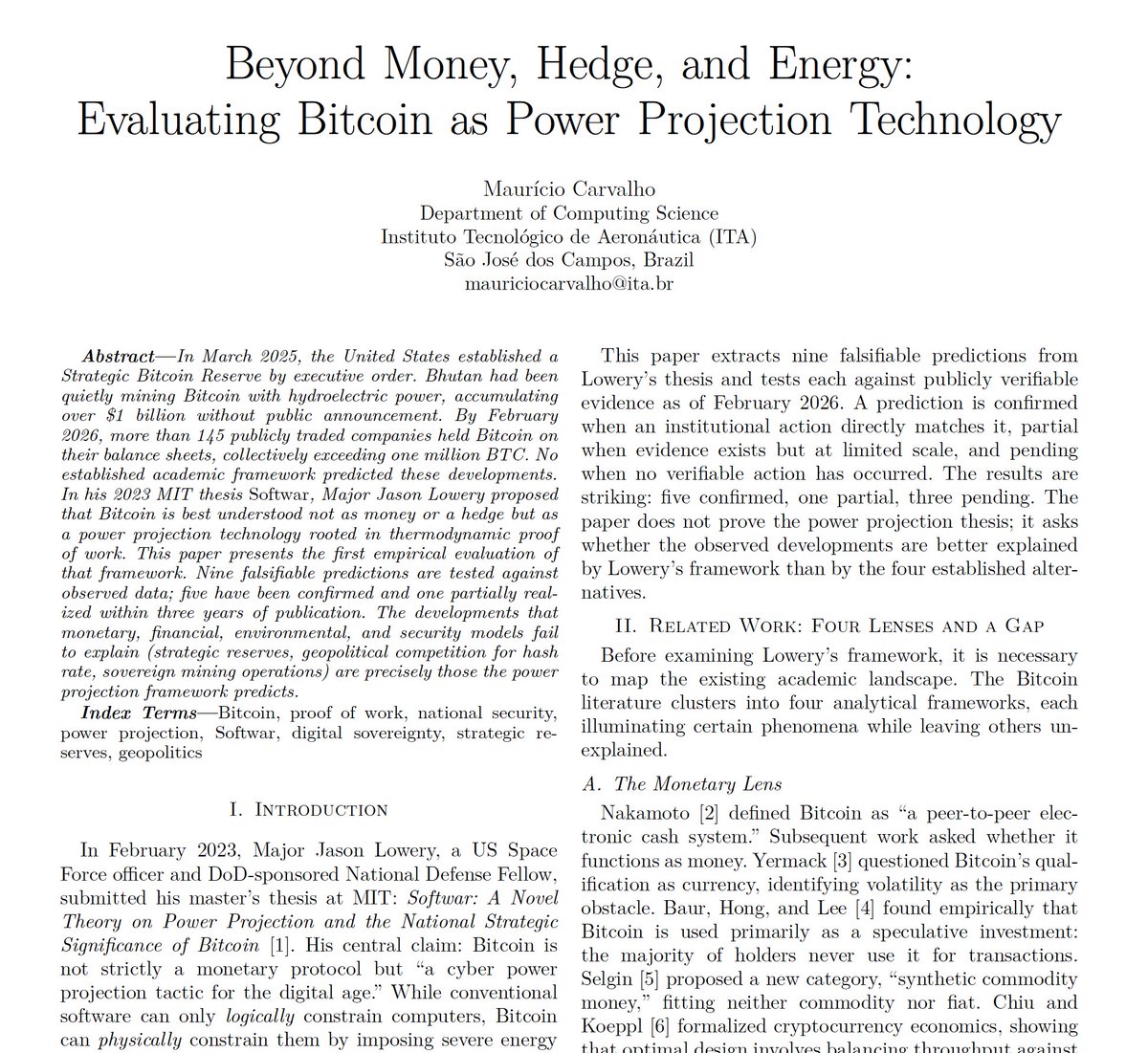
The author of a new paper: "Beyond Money, Hedge, and Energy: Evaluating Bitcoin as Power Projection Technology" evaluates Jason Lowery's 2023 "SOFTWAR" theory that said Bitcoin should be understood as a way to project physical power into cyberspace.
Normally, computers run on “rules” and software. But Bitcoin works differently. It uses huge amounts of real electricity and energy to secure its network. That means attacking Bitcoin isn’t just about hacking code - you would have to spend massive amounts of real-world energy and money to overpower it. The paper tests whether that theory was right by looking at what happened between 2023 and 2026.
Here’s what actually happened:
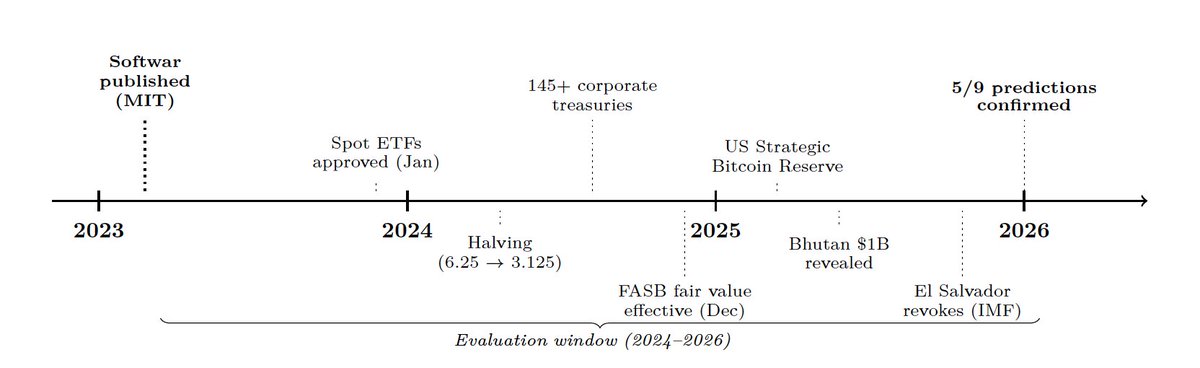
1) The United States created a Strategic Bitcoin Reserve (basically treating Bitcoin like a national resource, similar to oil).
2) Countries like Bhutan secretly mined Bitcoin using hydroelectric power.
3) Over 145 public companies added Bitcoin to their balance sheets.
4) Huge investment funds (like BlackRock’s Bitcoin ETF) bought tens of billions of dollars worth.
5) Global Bitcoin mining power (called “hash rate”) hit record highs - even while the price dropped.
That’s important. The price of Bitcoin fell about 46% during this time. But governments and big institutions were buying more of it anyway. According to the paper, that suggests they may see Bitcoin as something strategic - not just an investment.
The paper says older ways of thinking about Bitcoin don’t explain this behavior:
It’s not just money.
It’s not just a speculative investment.
It’s not just bad for the environment.
It’s not just a tech experiment.
Instead, the author says Bitcoin may be more like digital territory protected by energy. If you control energy and computing power, you help protect the network. Countries might compete for that power the same way they compete for oil, weapons, or technology.
The paper checked nine predictions made in 2023 about what would happen if Bitcoin really was a “power projection technology.” Five of those predictions already came true. One partly happened. Three haven’t happened yet.

过去几年,我一直为阿联酋屡次被评为全世界最安全的国家/城市的记录而感到骄傲,事实也的确如此。这里基本可以做到路不拾遗,你可以在晚上在任何一个街道走路,不用担心出行问题。
但是不出意外的话,意外/无常总是会用一种想不到的方式,打破我们的观念和执着。比如阿布扎比和迪拜的确是很安全,但现在看来,是一种城市治安层面的安全;阿联酋虽然中立,但依然有美军基地,这也构成了伊朗的无人机和弹道导弹攻击的逻辑,在迪拜都造成了地标性建筑物的威胁和损伤,比如,棕榈岛,机场Terminal 3,也就是著名的阿联酋航空的主航站楼,还有七星级帆船酒店。
关于黄金。这次的情况,让我再次思考黄金的问题。随着领空和路上口岸的封闭,我觉得在极端环境下,一个人在自己的居住地储藏实物黄金,都是有问题的,因为你可能么有办法带上他离开你的居住地。实物黄金在极端环境下,是一种“本地化”很强的资产。除非你像现在很多的美国富豪一样,人在美国,然后去新西兰造碉堡,同时把黄金储藏在那里的地下室。这条路对大多数普通人,也没有借鉴意义。
关于比特币。比特币在这次的冲突中,依然扮演着24/7可交易的数字风险资产的角色,当市场的情报已经相信哈梅内伊死亡了以后,比特币的价格和Polymarket上的哈梅内伊死亡的概率,都直接大涨了。所以从这个角度来说,很多时候,我们要相信群体智慧(Wisdom of the Crowd )。 我觉得关于“比特币是数字黄金”这句话,现在说的太早了。黄金是黄金,比特币还是比特币。至于比特币未来会不会成为数字资产的避险工具,那可能还需要一代人的演化和观察。也可能最后比特币也未必需要成为避险工具(关于他和市场的相关性),最后就是数字资产的价值储藏。
关于多元化。我在阿联酋的有些朋友,自己的财富大头就是不断的积累在阿布扎比和迪拜的房地产。这在投资和金融学上叫做“Home Bias”,也就是因为热爱自己的家乡(或者第二故乡),最后过度配置,就和中国大多数的居民绝大多数的财富都是中国房地产这一个单一类别一样。我也经常劝大家,其实多元化,无论是资产的多元化,地域的多元化,都是一种反脆弱,都是一种对世事无常的“安全边际”的表达。就是说,承认自己的无知和渺小的,那么多元化,就是一种安全边际的表达。
我之前写过一篇《如何在战争中保全生命与财富》,也供大家参考,祝大家都能够在这个乱世中,照顾好健康,生命和财产。

we're making @blocks smaller today. here's my note to the company.
####
today we're making one of the hardest decisions in the history of our company: we're reducing our organization by nearly half, from over 10,000 people to just under 6,000. that means over 4,000 of you are being asked to leave or entering into consultation. i'll be straight about what's happening, why, and what it means for everyone.
first off, if you're one of the people affected, you'll receive your salary for 20 weeks + 1 week per year of tenure, equity vested through the end of may, 6 months of health care, your corporate devices, and $5,000 to put toward whatever you need to help you in this transition (if you’re outside the U.S. you’ll receive similar support but exact details are going to vary based on local requirements). i want you to know that before anything else. everyone will be notified today, whether you're being asked to leave, entering consultation, or asked to stay.
we're not making this decision because we're in trouble. our business is strong. gross profit continues to grow, we continue to serve more and more customers, and profitability is improving. but something has changed. we're already seeing that the intelligence tools we’re creating and using, paired with smaller and flatter teams, are enabling a new way of working which fundamentally changes what it means to build and run a company. and that's accelerating rapidly.
i had two options: cut gradually over months or years as this shift plays out, or be honest about where we are and act on it now. i chose the latter. repeated rounds of cuts are destructive to morale, to focus, and to the trust that customers and shareholders place in our ability to lead. i'd rather take a hard, clear action now and build from a position we believe in than manage a slow reduction of people toward the same outcome. a smaller company also gives us the space to grow our business the right way, on our own terms, instead of constantly reacting to market pressures.
a decision at this scale carries risk. but so does standing still. we've done a full review to determine the roles and people we require to reliably grow the business from here, and we've pressure-tested those decisions from multiple angles. i accept that we may have gotten some of them wrong, and we've built in flexibility to account for that, and do the right thing for our customers.
we're not going to just disappear people from slack and email and pretend they were never here. communication channels will stay open through thursday evening (pacific) so everyone can say goodbye properly, and share whatever you wish. i'll also be hosting a live video session to thank everyone at 3:35pm pacific. i know doing it this way might feel awkward. i'd rather it feel awkward and human than efficient and cold.
to those of you leaving…i’m grateful for you, and i’m sorry to put you through this. you built what this company is today. that's a fact that i'll honor forever. this decision is not a reflection of what you contributed. you will be a great contributor to any organization going forward.
to those staying…i made this decision, and i'll own it. what i'm asking of you is to build with me. we're going to build this company with intelligence at the core of everything we do. how we work, how we create, how we serve our customers. our customers will feel this shift too, and we're going to help them navigate it: towards a future where they can build their own features directly, composed of our capabilities and served through our interfaces. that's what i'm focused on now. expect a note from me tomorrow.
jack

看到消息说,Meta又要搞稳定币了。
* Meta为什么要卷土重来?
原因很简单,坐拥30多亿用户。
Facebook、Instagram、WhatsApp加起来,全球30多亿用户。要是这些App里直接塞进稳定币支付,类似于搞了给用户搞了一个加密钱包(虽然是整合第三方稳定币)。
想象一下:你在Ins上刷到个包包,直接用稳定币买了寄到家;或者阿联酋Whatsapp用户给印度的亲戚转钱,不用 SWIFT ,几毛钱手续费搞定。
Meta的目标就是这个:让支付像发消息一样简单,顺便还可以赚些手续费。
* Meta也不是第一次要搞稳定币
2019年他们推出Libra(后来改名Diem),想搞个全球稳定币(由一篮子法定货币支撑),结果被美监管机构大棒一顿砸,项目黄了。资产卖给了Silvergate 银行,后来前团队成员还出来搞了Aptos和Sui两条新链。
这次,Meta卷土重来,这次他们不自己发币了,而是“借鸡生蛋”——通过第三方合作伙伴整合现有的美元挂钩稳定币(如 USDC 或 USDT),并推出新的钱包来支持 Facebook、Instagram 和 WhatsApp 等平台的支付功能。
这种玩法可以减少监管风险,避免像上次那样被视为挑战央行货币的主权行为。目标是实现即时跨境转账,而无需传统银行费用,这可能为加密行业带来超过 30 亿潜在新用户。整合预计在 2026 年下半年启动,目前处于测试阶段。
合作伙伴目前看,Stripe是最热门的(Stripe用11亿美元收购了Bridge稳定币平台)。Bridge 支持企业发行自定义稳定币或整合现有稳定币,支持美元挂钩资产的发行、管理和支付。
Meta 不会直接发行新币,而是依赖 Bridge 等平台来处理支付和钱包实施。这种合作模式类似于 Meta 过去与 Stripe 在传统支付领域的长期关系,不过如今扩展到区块链。
* Meta稳定币整合对于加密的影响
Meta的稳定币大概率是会支持多链运行,其中也包括以太坊L1/L2,Solana等。
具体到以太坊方面,现在全球稳定币里,目前超过一半(很多时候60%+)都在以太坊上跑,尤其是USDC和USDT这些大头。Meta不自己发新币,而是整合现成的稳定币(大概率USDC或类似),通过Stripe的Bridge平台来搞支付。
Bridge也支持以太坊和它的L2(像Base等),Stripe的Tempo链也兼容以太坊生态。Meta的30亿用户用稳定币支付,其中会有部分交易落在以太坊主网+L2上。如果交易量足够规模,即便gas费用非常低,整体上也会产生可观gas费,从而烧毁相应规模的ETH。至于能带来多少,目前还无法预测。
此外,一旦Meta多数用户都使用稳定币,这对于更多用户了解并进入加密领域有帮助,随着用户熟练使用稳定币,会逐渐接触到加密借贷/交易/质押等,也会有部分新用户进入加密。
日历
3 月 5 日
数据请求中